





















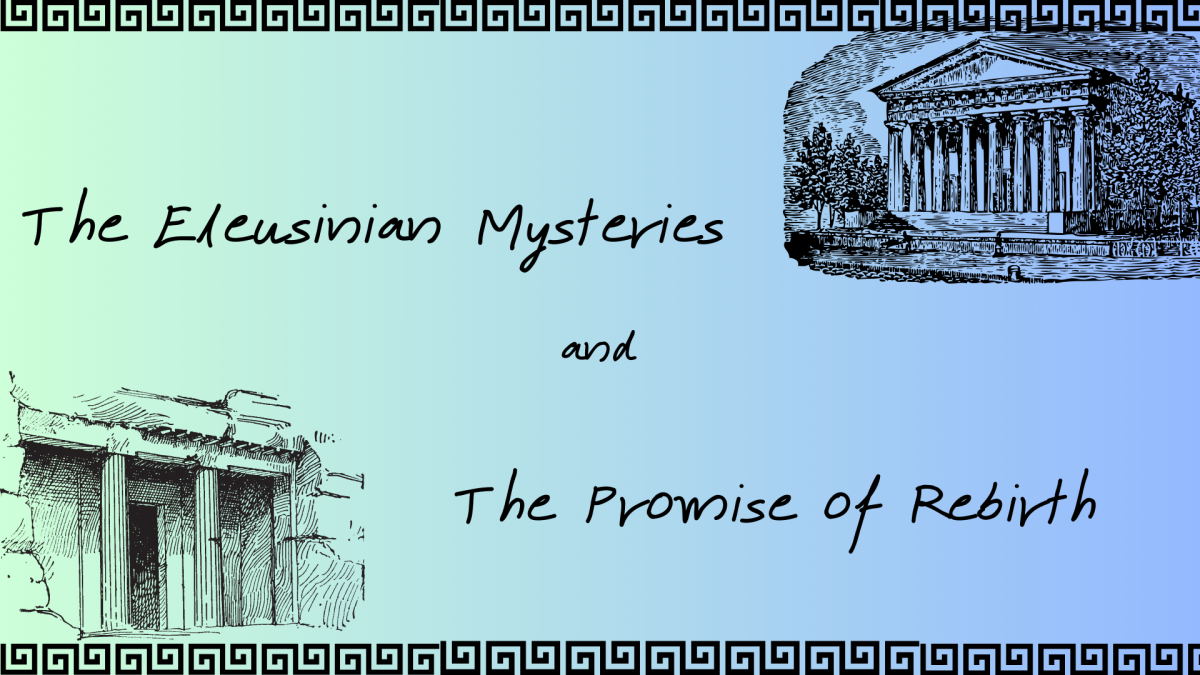


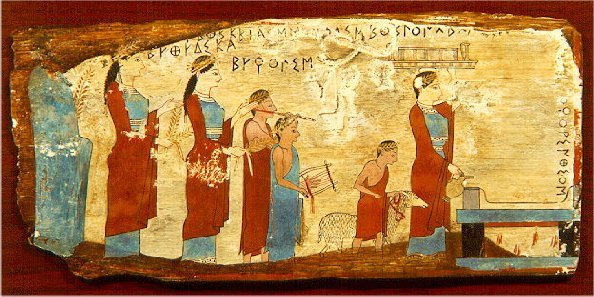
 The Eleusinian Mysteries were observed by nearly all Hellenic people, particularly the Athenians, due to the integration of Eleusis and Athens. Celebrated annually at Eleusis, the Mysteries transformed from a local cult into a major Panhellenic institution, and eventually under Roman influence, came to represent a form of universal worship. However, despite their widespread observance, the rites were carefully concealed from the uninitiated. If any person happened to reveal any part of themselves, they were regarded as having offended against the divine law, and by the act he rendered himself liable to divine vengeance.
The Legend which formed the basis of the Eleusinian Mysteries went as follows, Persephone (Proserpina) was abducted by Hades (Pluto) with the help of Zeus (Jupiter) and Demeter (Ceres), Persephone’s mother, wasn’t able to glimpse her daughter’s abductor. Demeter wandered for nine nights in search of Persephone where she eventually arrived at Eleusis, and was honourably entertained by Keleos, the ruler of the country, and his wife Metanira.
Athenians of any gender were usually granted the privilege of initiation during childhood on the presentation of their father. All people were encouraged to be initiated no matter the gender or age, and neglect of the ceremony came to be regarded almost in the light of a crime. Socrates, for instance, was reproached and regarded with suspicion for declining to participate. Even the Emperors of Rome came to request the honour of initiation.
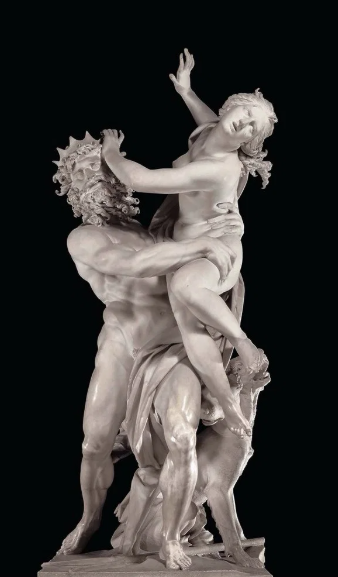 At its core, the Eleusinian Mysteries centered on the fertility of the land, the harvest cycle, and the broader theme of life, death, and rebirth. These rites symbolized not only agricultural renewal, but also the spiritual regeneration of the soul. The Lesser Mysteries, held earlier in the year were distinct in both tone and function. They symbolized the return of Persephone to the world above and was an allegory of the soul’s temporary liberation from the physical world. In contrast, the Greater Mysteries held annually in autumn unfolded over a period of ten days, during which participants engaged in a series of highly structured rituals. The Hellenic, or Greek worldview, did not have a sharp distinction between religion and civic life, the veneration of deities were essential to both communal and personal life.
On the first day, initiates who had gone through the Lesser Mysteries gathered in Athens and sacrificed for the well being of the Hellenic world.
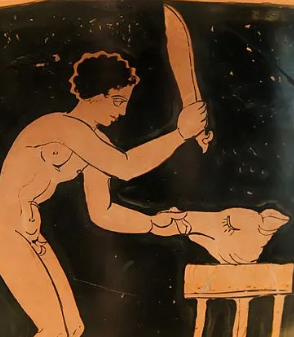
The second day, initiates bathed and purified themselves in the sea. Each had carried to the river a small pig, which was also bathed and purified.
The third day was a day of mourning. Pleasure was forbidden as participants fasted until nightfall to commemorate Demeter’s grief. The piglets purified the previous day were sacrificed as ritual substitutes for the initiates’ own impurities.
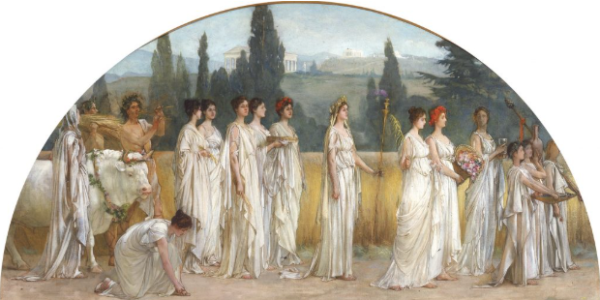
 On the fourth day, a solemn procession with the holy basket of Ceres (Demeter) was carried in a consecrated cart, while crowds of people shouting as it went along, “Hail, Ceres!” Towards the end of procession, women carried baskets filled with grain, fruit and sometimes serpents.
The Day of Torches, or the fifth day at nightfall, all the initiates walked in pairs around the temple of Demeter at Eleusis, the torch bearer led the procession. The torches were waved about and changed from hand to hand, to represent the wanderings of the goddess in search of her daughter when she was conducted by the light of a torch kindled in the flames of Etna.
On the sixth day of the mysteries, the statue of the “fair young god,” Iacchos, or Dionysos, or Bacchus who accompanied Demeter in her search for Persephone. The statue of Bacchus was taken from the Iacchion, the sanctuary of Iacchos in Athens and mounted on a heavy rustic four-wheeled chariot drawn by bulls and brought to Eleusis by the Sacred Way in solemn procession.
On the seventh day the statue was carried back to Athens. The return journey was also a solemn procession, and attended with numerous ceremonies. For those who remained in Eleusis observed athletic contests, with victors rewarded with barley due to the tradition that grain was first sown in Eleusis.
The eighth day was called Epidaurion, this name was in honour of Asclepius, because they still initiated him when on one occasion he arrived from Epidaurus too late for the mysteries. It therefore became customary to celebrate the Lesser Mysteries a second time upon this day, and to admit to initiation any such approved candidates who had not already enjoyed the privilege.
The ninth day was known as the Day of Earthen Vessels, because it was the custom on that day to fill two jugs with wine. One was placed towards the East and the other towards the West, and after the repetition of certain rituals both cups were thrown and wine was spilled upon the ground as a libation. The first of these cups was directed towards the sky as a prayer for rain, and the second to the earth as a prayer for fertility.
On the tenth day, the majority of the people returned to their homes, with the exception of every third and fifth year, when they remained behind for the Mystery Plays and Sports, which lasted from two to three days.
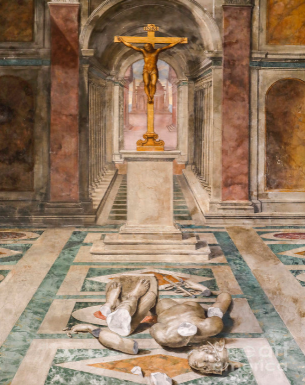
The ideas behind the Eleusinian Mysteries still hit close to home, they were about loss, hope and finding light after darkness. The ancients used rituals and community to make sense of life’s biggest questions, just like we turn to music, stories or traditions to do the same. The Mysteries were banned in the 4th century as Christianity spread through the Roman Empire, but their spirit never completely disappeared. Some modern groups and festivals still celebrate newer versions of the ancient rites or retrace the steps of the pilgrimage, keeping their message of renewal and connection alive. Reading about them isn’t just learning history, it is about seeing how people have always searched for meaning, community, and a fresh start.




Pax Stanglewicz • Dec 8, 2025 at 2:33 PM
Btw persephone’s original name before being abducted and becoming queen of the underworld was Kore, meaning “maiden” or “girl”. It was later changed to Persephone (the bringer of darkness) to fit with her new role.
Pax Stanglewicz • Dec 8, 2025 at 2:28 PM
I’m actually screaming I have gotten really into Hellenism recently and I love all of your papers so much they are all really in depth and interesting!!!